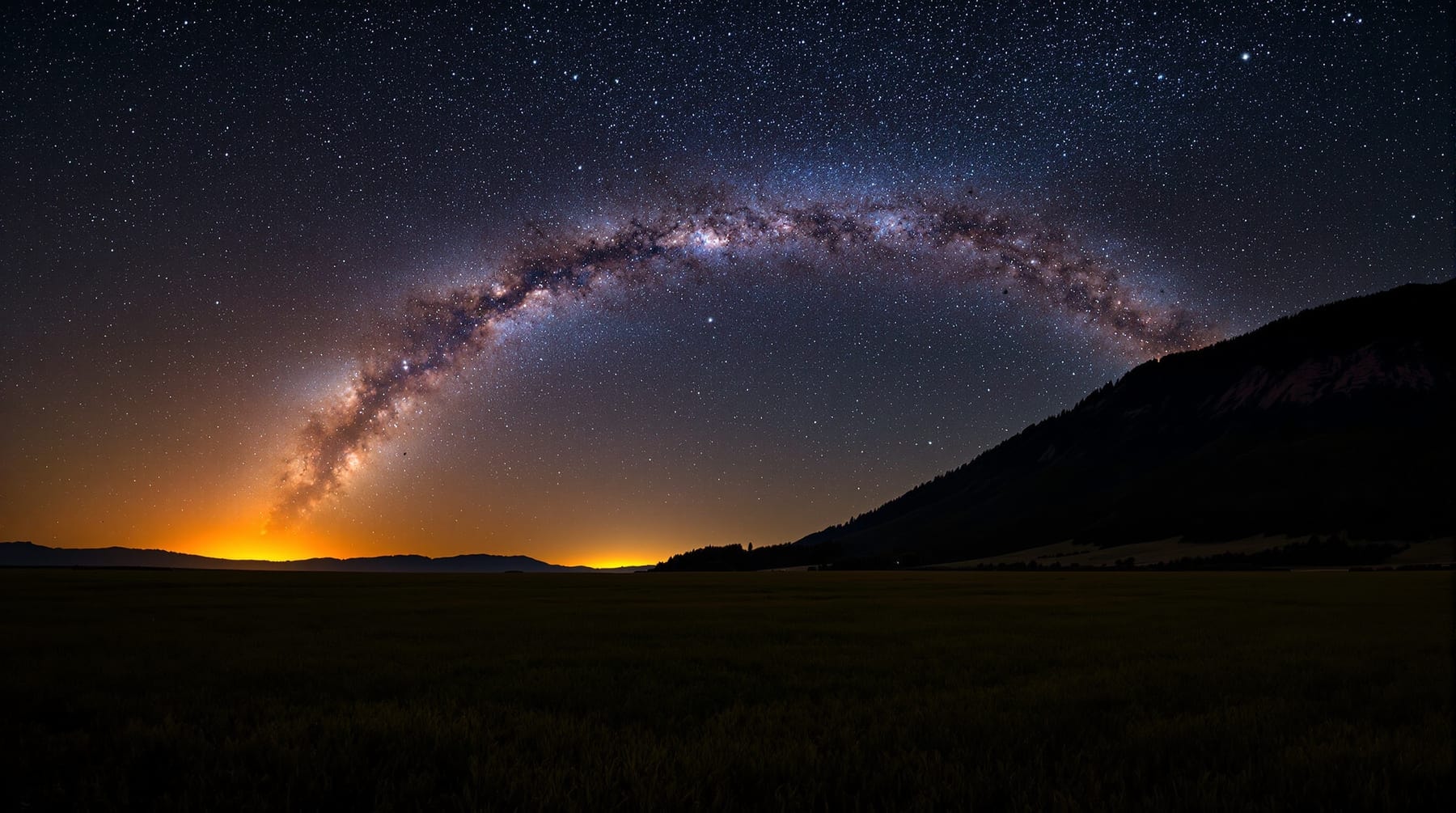
This is an independent guide to stargazing in British Columbia's Fraser Valley. It is written for people who live somewhere between Langley and Hope, who have noticed that the sky above them still has stars in it on the right night, and who want to know where to stand, what to look at, and what all that orange glow on the western horizon is actually doing to the view.
The valley is an awkward and rewarding place to be an amateur astronomer. It sits at roughly 49 degrees north, which puts the whole northern sky permanently on display and cuts the deep southern sky off at the knees. It is wedged between the Metro Vancouver light dome to the west, the Chilliwack and Abbotsford glow at ground level, and a wall of mountains that both blocks the sky and blocks other people's lighting. It rains a great deal. And then, three or four times a month between September and April, the cloud tears open, the air behind a departing front is unusually steady, and the Milky Way comes out over Sumas Mountain looking like something from a much darker part of the world.
What this guide covers
The material here is organised around the questions a valley observer actually asks, in roughly the order they ask them.
- Where do I go? The valley has one genuinely protected dark-sky site and a handful of good improvised ones. The McDonald Park dark-sky park page covers the first in detail, and observing sites in the Fraser Valley and southern interior covers the rest, from Chilliwack Lake up to the Kane Valley plateau behind Merritt.
- What is up tonight? The seasonal sky guide for 49 degrees north works through the year season by season, including which constellations never set here and which famous southern objects you will never see at all.
- Will it be clear? Cloud is the limiting factor on this coast far more often than light pollution is. Reading the forecast explains transparency, seeing, and the specialist astronomical forecasts that were built for exactly this problem.
- Why is the sky so bright? Light pollution over the Lower Mainland covers the Bortle scale, where the skyglow domes sit, and how to read a light-pollution map without misinterpreting it.
- What do I buy? Binoculars, telescopes and eyepieces is deliberately conservative advice, and the binocular box is the cheapest genuinely transformative thing in amateur astronomy.
- Can I make one? The telescope-making section covers grinding and polishing a mirror, testing it with a knife edge, building the tester itself, and assembling a plywood Newtonian around the finished optic.
The guide also follows light pollution indoors, where a poorly aimed fixture becomes a bedroom problem rather than only a lost-sky problem. The expanded page on intrusive lighting and the body clock explains how timing and wavelength matter, then keeps the practical order clear: correct the source where possible, interrupt spill at the window and manage the light produced inside the room.
The valley's one great advantage
Most metropolitan regions of two and a half million people have no dark sky within an hour's drive. The Fraser Valley does, and it is largely an accident of geology. Sumas Mountain rises abruptly out of the flat farmland east of Abbotsford, and a municipal park tucked against its flank sits in the mountain's shadow with respect to light as well as terrain. Abbotsford's glow is behind the ridge to the west, Chilliwack's is screened to the east, and Mission's is cut off to the north. What is left is a wide, low, dark southern and eastern horizon over agricultural land — which happens to be exactly the direction you want when the summer Milky Way is up.
That site did not stay dark by luck alone. Over a period of years the nearby highway interchange lighting was reduced, street lights on the approach roads were converted to full-cutoff optics that throw their light down instead of sideways, and at least one neighbouring farm changed its yard light voluntarily. The story of how the valley got a dark-sky park is a matter of municipal public record and is worth reading, because it is a rare example of light pollution being reversed rather than simply lamented.
How to use the sky at this latitude
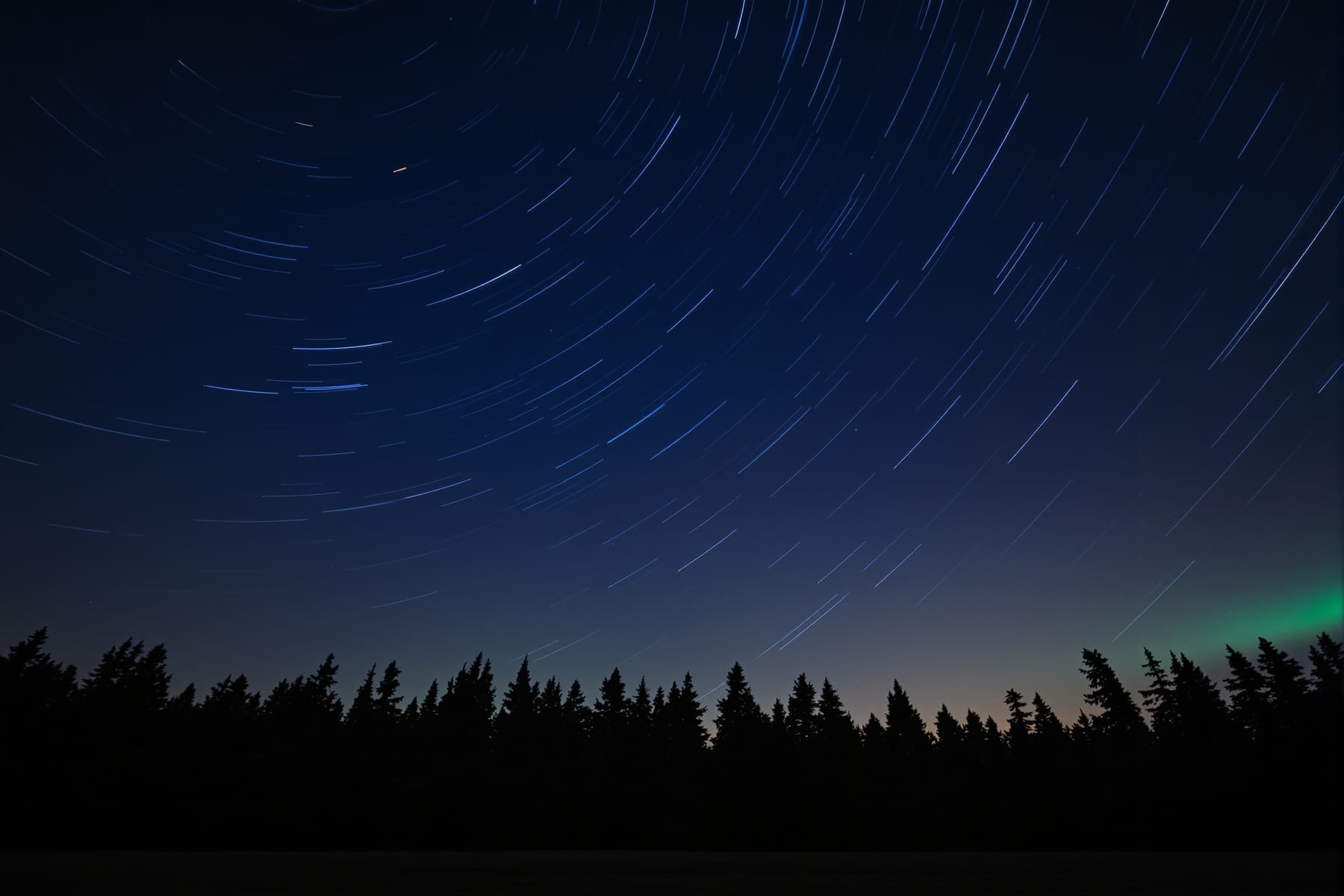
At 49 degrees north the celestial pole sits 49 degrees above the northern horizon — roughly halfway up. Everything within 41 degrees of the pole is circumpolar: it circles the pole all night, every night, and never sets. That gives valley observers permanent access to the Big Dipper, Cassiopeia, Cepheus, Draco and most of Perseus, whatever the season.
The same geometry takes things away at the other end. The centre of our own galaxy, in Sagittarius, never climbs higher than about twelve degrees above the southern horizon from here, which means you are always looking at it through several times as much atmosphere as an observer in Arizona — and, from the valley floor, through the airglow of a border's worth of towns. Canopus, the second-brightest star in the sky, never rises at all. Learning which objects are genuinely worth chasing from this latitude, and which are better left to a trip south, saves a lot of frustration.
One more piece of local geometry matters in June. At 49 degrees north the Sun does not get more than about 17 and a half degrees below the horizon at midnight around the summer solstice, which is just short of the 18-degree threshold astronomers use to define true darkness. For several weeks either side of the solstice there is no astronomical night here at all — the northern horizon stays visibly lit from dusk to dawn. It is the reason the serious observing season on this coast effectively runs from late August to early May.
Watching the aurora
The valley is far enough north to see aurora reasonably often and far enough south that most of what it sees sits low on the northern horizon rather than overhead. That combination is worth understanding before you spend a cold night waiting for something that was never going to reach you. The aurora page covers the geomagnetic activity levels that actually matter at this latitude, where the northern sightlines are from the valley floor, which forecasts are worth watching, and why a display that looks grey to the eye photographs bright green.
An independent, non-commercial guide
Nothing here is for sale, and this guide is not connected to any astronomy club, society or organisation. It does not run events, take bookings, sell equipment or accept advertising. Where a piece of software, a book or a technique is mentioned, it is mentioned because it is useful, not because anyone paid for the mention. Prices, opening arrangements and access rules for public land all change; treat everything here as background reading and check current conditions for yourself before you drive somewhere at midnight.
For a fuller statement of what this site is and is not, see the about page. For forecasts, charts, atlases and the handful of other reference sites worth keeping bookmarked, see night-sky resources.